How to Get Your Digital Tools to Work Together to Save Time
Learn how to connect your apps to automate customer management, eliminate manual work, and respond to requests faster.
Alessandro opens his business management software, checks his email, and glances at WhatsApp Web. Three windows, three different ways to receive requests. One client asked for a quote via email, another messaged on WhatsApp to see if they could meet tomorrow, and a third filled out the form on the website. It’s only 10:30 a.m., and he’s already wasted nearly three-quarters of an hour switching between screens, copying numbers, and pasting replies.
Technology promised to simplify work, but instead it often complicates it because it keeps everything separate. Figuring out how to get the tools you use to communicate with each other doesn’t require advanced technical skills. Above all, it helps you stop manually shuttling back and forth between apps and respond to customers without wasting precious time.
What It Really Means to Get Your Tools to Talk to Each Other
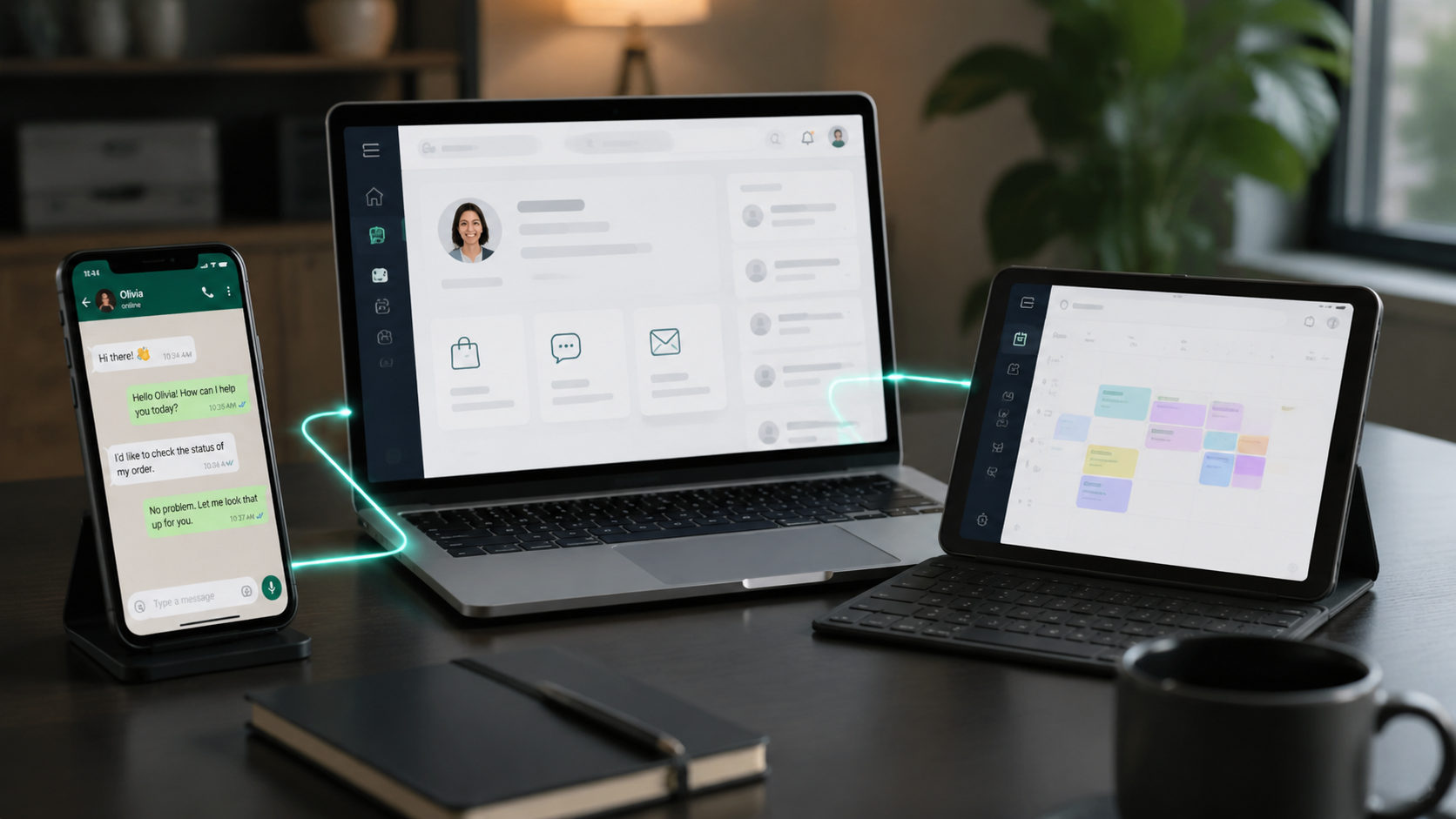
When a customer enters their information somewhere, it should automatically end up where you need it without you having to copy it. It’s not about installing complicated systems or calling an IT specialist. It’s about creating an automatic flow between the apps you already use, so the information moves on its own.
Imagine a dental practice that receives appointments through its website. If the form is linked to the schedule, the patient’s name and chosen time slot go directly into the calendar, and the patient immediately receives a confirmation on WhatsApp. Each tool does its job and passes the baton to the next one, without constant manual intervention. Ultimately, you don’t need to accumulate a bunch of different programs—you just need the few you have to exchange data effortlessly.
Why Scattered Data Causes You to Lose Customers
When a request goes unanswered for too long, the customer often turns elsewhere. You don’t need statistics to understand this—just try calling someone back after a couple of days and hearing the phrase “I’ve already found a solution.” Fragmentation creates exactly this problem, because you keep information scattered across email, WhatsApp, your management system, and maybe a shared spreadsheet.
Every minute you spend moving data from one place to another is a minute less dedicated to people. The European program for digital transformation emphasizes creating useful connections, not digitization for its own sake. For small business owners, this simply means being able to respond faster than the competition.
How to Choose Tools Without Complicating Your Life
You don’t need to learn how to code. You just need to look for software that offers ready-made integrations, which can be activated in just a few steps. When evaluating a new tool, first check if the website has a section dedicated to integrations: if it’s empty or nearly so, it means that program will remain isolated, and it’ll be up to you to bridge the gap.
Next, choose platforms that work on the channels your customers already use. If most of them message on WhatsApp, it doesn’t make sense to add software that only handles website chats, because you’d end up with two tools instead of one. The question to ask yourself is always the same: Does this program eliminate steps or add them? If the answer is the latter, it’s best to skip it.
Automation That Really Helps You
Useful automation isn’t a robot that replaces you. It’s a system that gathers basic information and delivers it to you ready to go. Let’s take the dental office example again: when a patient messages on WhatsApp to make an appointment, a simple automation can ask for their name and preferred day and send the receptionist a pre-filled form.
This way, the receptionist can use her time to handle emergencies or reassure anxious patients, instead of repeating the same questions over and over. Automation takes care of the predictable tasks, while you focus on what truly requires human interaction.
Data Security, Without Complications
You don’t need a cybersecurity course. Just follow one clear rule: use only platforms that comply with European regulations and clearly explain how they handle customer data. European rules on data protection and artificial intelligence exist precisely to provide you with a secure framework, without requiring you to verify every technical detail.
Transparency is the most important indicator. If a software program doesn’t make it clear where your customers’ information ends up, it’s best not to use it.
Where to Start to Truly Simplify
Don’t try to change everything at once. Start with the part that wastes the most time. For three days, make a note every time you switch between apps to handle customer requests. Almost always, one main bottleneck emerges: requests that come in through different channels and remain scattered.
If you want to try consolidating website chats and WhatsApp into a single interface without adding too many tools, Leader24 offers a 30-day free trial. The goal isn’t to add yet another program, but to replace two or three separate tools with one that acts as a hub.
Frequently Asked Questions
Do I have to use paid software?
Not always, but free tools rarely offer effective integrations. You can get by at first, but as the volume of requests increases, the time wasted acting as an intermediary often exceeds the cost of a program that handles everything automatically. So weigh the hours you’ll save against the monthly fee.
How long does it take to set everything up?
It depends on your initial choice. Platforms with native integrations usually take less than an hour to set up thanks to guided procedures. If, on the other hand, you try to connect software designed to operate in isolation, you risk wasting days without concrete results.
How can you tell if a software program is reliable when it comes to data?
Check three simple aspects: the company’s location (preferably in Europe), the presence of a clear privacy page, and whether the privacy policy is written in clear, understandable Italian. If the text seems unnecessarily complicated, that’s a red flag you shouldn’t ignore.
Start by keeping notes for three days on where you’re wasting time. Once you’ve identified the critical issue, look for a tool that solves it and try it out for a few weeks. You don’t need a revolution—you just need to remove a specific roadblock that lets you finish your day sooner and respond better to customers.
Leader24 Insights
If you’d like to learn more about how Leader24 addresses the topics covered, here are some resources to get you started:
Ready to transform your customer service?
Activate your AI assistant on WhatsApp in 5 minutes. 30-day free trial, no credit card required.
Fonti
Related articles

Smart TVs in the Office: How to Protect Your Customers' Privacy
A Smart TV in the waiting room can compromise data security. Learn how to set up your devices correctly and protect your practice's network.

How to Create Visual Workflows to Automate Your Work
Learn how to automate business processes without writing code, using visual workflows to save time and better manage your customers.

Proprietary or Open-Source Software: How to Choose the Right Solution
Is proprietary software better than open-source software? Find out how to evaluate time, costs, and expertise to choose the right technology for your business.