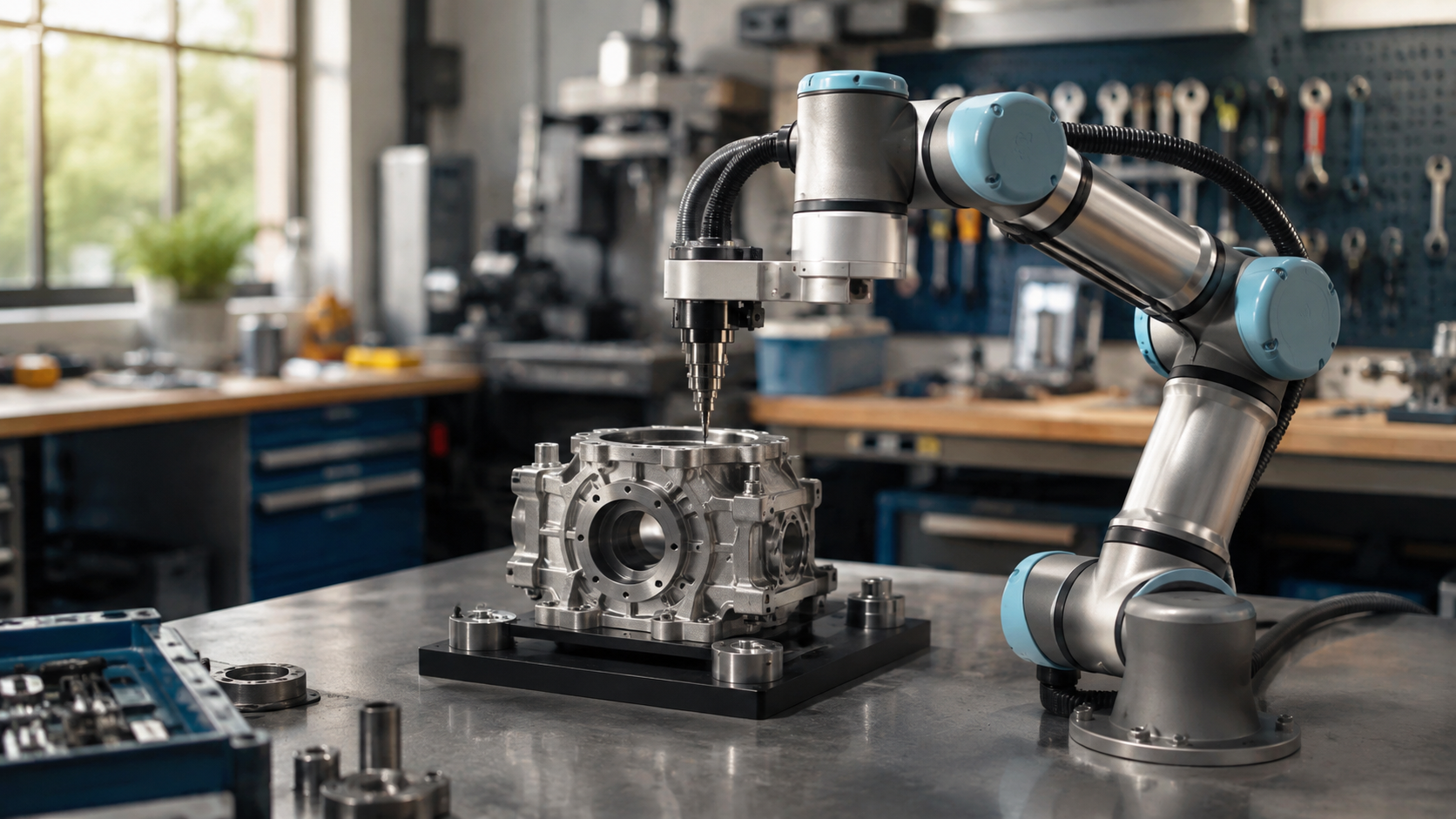
Collaborative Robotics: How to Automate Your Production
Find out how cobots can optimize your workshop, freeing operators from repetitive tasks and boosting efficiency without any major changes.
The production order is clear: 200 pieces by Friday. Yet your most experienced operator is tied up for hours loading and unloading raw parts from the machine tool—a task that requires no special skills but ends up slowing down the entire department. This isn’t a staffing issue, but rather a matter of how work is organized. Robotics collaborative was created precisely to resolve these kinds of bottlenecks, freeing people from repetitive tasks without eliminating jobs.
What’s the difference between a traditional robot and a cobot?
A classic industrial robot is powerful and fast, but it must operate in isolation within safety cages. If an operator approaches while the robot is moving, there’s a real risk of an accident. A cobot, on the other hand, is designed to share space with people: it stops at the slightest contact and does not require physical barriers. The main difference lies in modularity. A traditional robot requires extensive restructuring and a production layout built around it, while a cobot fits into the existing workflow. You can move it where it’s needed, reprogram it for a different task, and adapt it to current needs. The operator handles complex parts, while the cobot manages repetitive handling tasks: two distinct roles that integrate on the same workbench.
Why is collaborative robotics ideal for small businesses?
Small businesses cannot afford to halt production for months while installing a robotic cell, nor do they have the production volumes needed to recoup very high investments. Collaborative robotics changes the game because it allows you to start with targeted interventions, one workstation at a time. Automation powered by artificial intelligence, when integrated into these settings, achieves a significant increase in operational efficiency compared to traditional automation. This figure is interesting, but flexibility matters even more: if you’re producing 500 units of one type today and need to switch to 200 of another tomorrow, the cobot can be reprogrammed in just a few minutes without having to redesign the entire line.
How can the relationship between humans and machines be managed without stress?
The key lies in dividing tasks sensibly. The cobot handles what is strenuous, monotonous, or ergonomically taxing: screwing, performing repetitive spot welding, moving heavy parts, or palletizing. The operator retains control, supervision, and exception handling—those cases where a human eye, experience, and decision-making ability are needed. In a medium-sized metalworking company, while the cobot assembles standard components, the operator can focus on urgent customer requests. The machine doesn’t replace anyone—it simply frees up resources.
What are the first steps to getting started with automation?
You don’t need a 40-page strategic plan. The first step is to map out the most repetitive and least value-added tasks in your typical workday. Take a sheet of paper and record, for exactly one week, what your operators do and how much time they spend on each task. Then choose the simplest task among those that take up the most hours. Not the most complex one to automate, but the most straightforward: loading a part into a machine, unloading a finished tray, or applying a label. The goal is to achieve a visible result quickly, so the team sees the benefit and begins to trust the change.
Does collaborative robotics take away jobs?
It’s the question everyone asks, and it’s a legitimate one. The short answer is no: it creates new opportunities. The more detailed answer is that the adjective “collaborative” means exactly “designed to work with.” The cobot does not replace the operator but enhances their capabilities, taking over the strenuous parts of the job and freeing them up for higher-value tasks. Advanced automation and human labor can coexist to increase safety and creativity in production. Companies that adopt cobots tend to grow, not downsize, because they free up time to get more work done—not to do the same amount of work with fewer people.
How do you choose the right partner for integration?
Look for a partner that offers turnkey solutions and training for your staff. Even the best technology is useless if the people using it don’t feel comfortable with it after the first day. Be wary of anyone who offers you a cobot without first spending at least half a day in your production department observing how you work. Before purchasing, always ask for a demo in which the cobot performs a specific task that currently takes one of your employees two hours a day. Not a generic demonstration with standard parts, but your part, your cycle, your pace. If the technical partner agrees without hesitation, you’ve found the right partner.
When It’s NOT Worth Investing in a Cobot
A cobot isn’t the right solution if you produce one-off batches that are all different, with setups that change every hour. In that case, frequent reprogramming ends up negating the time savings you’re hoping to achieve. It’s also not worth it if your main problem isn’t production but demand: automating a line that’s operating below capacity is pointless. First, fill your orders; then, ramp up production. A cobot is ideal when you have moderate volumes, sufficient repeatability, and want to grow without hiring just to cover seasonal peaks or low-value-added tasks. If this applies to you, start with a pilot station and measure the results after three months.
Frequently Asked Questions
How long does it take to install a cobot?
Much less time than a traditional robot. In many cases, it takes just a few days—not months—from unboxing to the first production run. The cobot mounts on a standard base, is programmed using guided touchscreen interfaces, and integrates into the existing layout without any structural modifications. Basic operator training takes a few hours, not weeks of classes.
Do I need to hire a specialized technician to program it?
No, and that’s one of the reasons cobots are designed for small businesses. Programming is often done through guided learning: you take the robotic arm, move it manually to the desired position, and save the point. Repeat for subsequent points, and the cycle is created. No coding is required.
How much does a cobot cost?
Prices vary based on payload, reach, and accessories, but the initial investment is a fraction of what you’d pay for a traditional industrial robot. Additionally, many companies offer operating lease or pay-per-use plans that convert the cost into a monthly operating expense, without tying up capital. Check the official price lists of the major manufacturers and always request a customized quote for your specific application. Take concrete action today: grab a piece of paper and write down the three most repetitive tasks in your production process—the ones that waste hours every day without adding real value. Choose the simplest one, find an integrator in your area, and request a demo using your part. Collaborative robotics isn’t a revolution that needs planning—it’s a step-by-step process, starting next Monday.
Article written with the help of AI.
Ready to transform your customer service?
Activate your AI assistant on WhatsApp in 5 minutes. 30-day free trial, no credit card required.
Fonti
Related articles

Perché il rallentamento dell'IA è un vantaggio per la tua azienda
I colossi tech rallentano lo sviluppo dell'IA: scopri perché questa prudenza rende i tuoi strumenti di automazione più stabili, sicuri e professionali.
Come semplificare il lavoro automatizzando i processi aziendali
Scopri come integrare i tuoi strumenti di lavoro, automatizzare le attività ripetitive e centralizzare le informazioni per eliminare il caos quotidiano.

Smart TVs in the Office: How to Protect Your Customers' Privacy
A Smart TV in the waiting room can compromise data security. Learn how to set up your devices correctly and protect your practice's network.