Human-Machine Collaboration: How to Automate Your Workshop
Learn how to integrate cobots, machine vision, and digitalization to optimize production in the workshop without disrupting existing workflows.
The order comes in at 5:45 p.m., and the customer wants it by the day after tomorrow. When you look at the production schedule, you immediately notice that the machines are already fully booked through Thursday, and the shift supervisor confirms the same situation. At that point, the only solution that seems to remain is to ask for overtime, with all the costs and stress that entails for the team.
In some factories, however, when an order like this comes in, the system analyzes the machine schedules, identifies a free slot on Line 3, automatically reschedules two less urgent batches, and asks the operator for a simple confirmation. Once the operator approves, production resumes smoothly without anyone having to scramble at the last minute.
This article explains how collaboration between people and machines works on the shop floor today, what it really takes to implement it in your own setting, and why you don’t have to be a major automotive group to achieve tangible results.
What “human-machine collaboration” really means on the factory floor
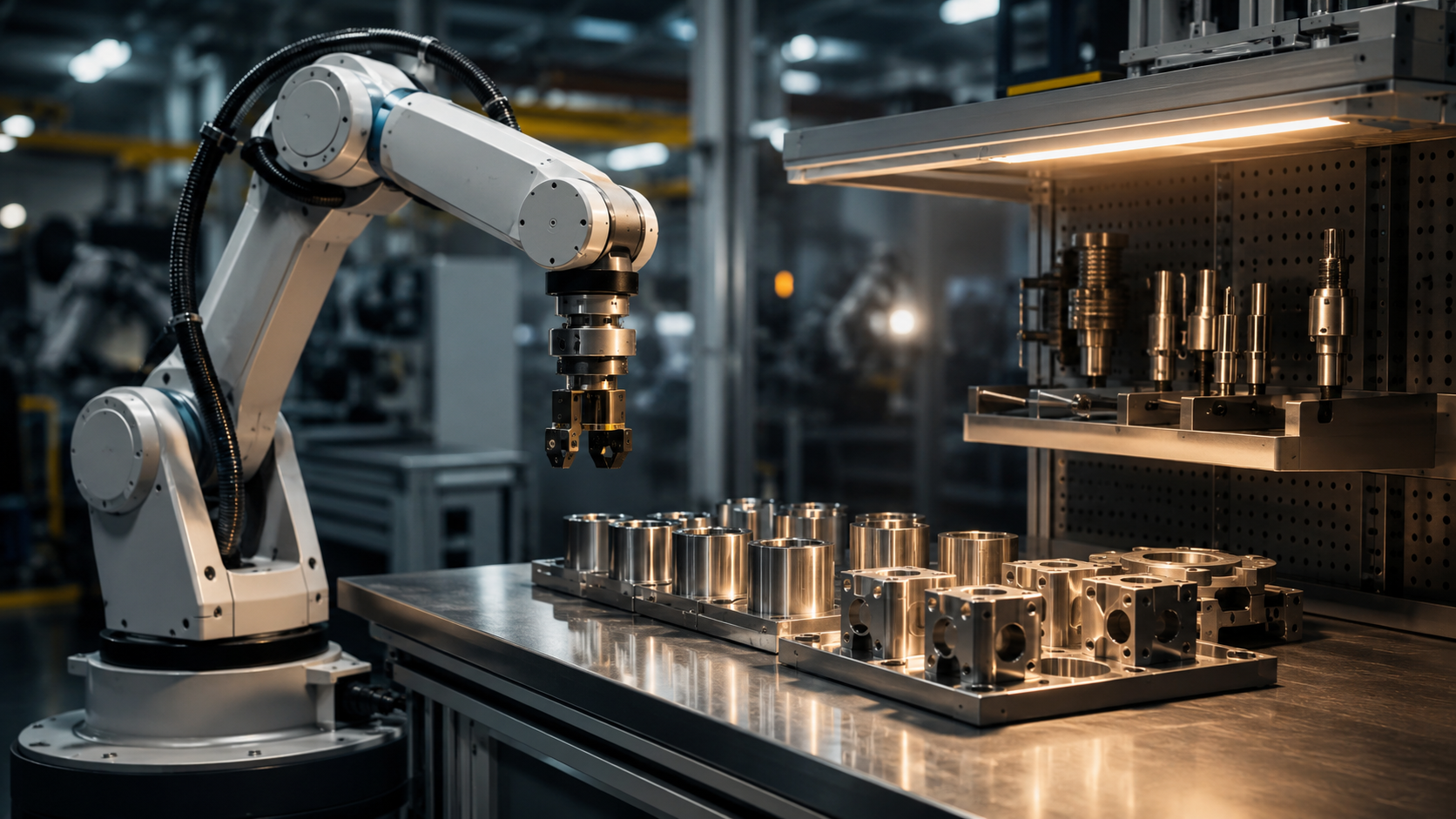
It means stopping to view the robot as a replacement for the operator. The cobot—that is, the collaborative robot—works alongside you and handles tasks that slow down the pace, such as part handling, repetitive screwdriving, or dimensional checks. You remain responsible for quality, decision-making, and all situations that require human judgment.
The current goal is no longer a completely dark, unmanned factory, but an environment designed around people. Cobots operate without safety cages thanks to sensors that immediately stop movement if they detect the presence of a human arm. In projects by the MICS consortium, companies such as Camozzi have documented cycle time reductions of up to 20% precisely because they eliminate downtime associated with waiting, movement, and retooling.
Why Machine Interconnectivity Is the Real Productivity Leap
Having a cobot that loads and unloads a machining center is already useful, but the greatest benefit comes when that cobot and machining center communicate with the management system, the warehouse, and the engineering department. Interconnectivity transforms every device into a source of real-time data. If the machining center detects tool wear outside tolerance limits, it doesn’t just turn on a warning light: it sends an alert to the production manager and halts the next part before it becomes scrap.
Production data automatically updates the inventory, so the purchasing department can reorder before running out of materials. The main advantage is that optimizing collaboration between operators and managers becomes possible: you no longer have to chase down problems—you see them coming well in advance.
How to Get Started Without Halting Production
No one is asking you to shut everything down and start from scratch. The most sensible approach is to proceed in incremental steps, working on three fronts simultaneously. The first involves collaborative robotics: introduce a cobot for a single operation, such as loading and unloading a machining center or palletizing. It can be installed in a few hours and programmed via imitation, by guiding it by hand so it records the movement. No safety cages are needed, and you don’t have to stop the line.
The second front is machine vision. An industrial camera with image analysis software can inspect 100 percent of the parts directly on the line and reject defective ones in real time, rather than performing spot checks at the end of the batch when many parts have already been processed. The third area is the digitization of data flows: the data that machines already generate—such as counters, alarms, and cycle times—is fed into software that transforms it into clear dashboards. This allows you to immediately identify bottlenecks and assess the line’s actual efficiency. As reflected in the more pragmatic approach to factory automation, the key is to transform that data into immediate operational decisions.
The Concrete Benefits for Small Businesses
The first benefit is flexibility. When the market demands increasingly smaller and customized batches, traditional robots prove too inflexible because reprogramming them for each variant takes time and money. Cobots offer superior operational continuity precisely because they allow you to switch from one process to another in just a few minutes without halting production.
The next benefit concerns people. Eliminating repetitive and physically demanding tasks reduces injuries, fatigue, and employee turnover. An operator who previously spent eight hours loading parts can now monitor two cells and intervene only when anomalies occur, working in a more relaxed manner. The third benefit is responsiveness to customers: if you can reconfigure a line in half an hour instead of half a day, you can accept orders you previously had to turn down and deliver them on time.
How to Manage Communications While Automating the Workshop
There’s a bottleneck that often arises precisely when you’re introducing new technologies. You’re in the workshop overseeing the integration of the cobot, but in the meantime, customers, suppliers, and couriers are messaging you on WhatsApp, email, and the phone. The time you devote to production automation is then lost responding to repetitive requests. If you don’t respond right away, the customer gets impatient, but if you respond personally, you lose precious hours every day.
The solution is to apply the same logic used in the workshop to communication as well: automate repetitive tasks so you can focus on what truly requires your expertise. You can set up smart automated responses that qualify inquiries, send basic quotes, and update order statuses, so the system alerts you only when your confirmation is truly needed.
Choosing the Right Tools to Get Started
You don’t need a 100,000-euro consulting project. You need tools that integrate seamlessly without disrupting what you’re already using. MES software monitors production in real time and collects data from machines, even starting with just a single production line. Vision systems for quality control are becoming increasingly affordable: there are compact solutions that can be mounted directly on your existing production line, such as those presented by Fanuc at Mecspe 2026, which come with built-in cameras and software.
For communicating with customers, a single platform that centralizes WhatsApp, website chat, and email prevents you from having to switch between three different apps while you’re on the shop floor. If you want to simplify this aspect without connecting five different tools, Leader24 combines live chat and WhatsApp management into a single dashboard, so important requests don’t get lost among notifications.
When Automation Isn’t Worth It
Don’t automate a process that doesn’t already work manually. If your production planning is chaotic, adding software on top of it only automates the chaos—it doesn’t solve it. First streamline your workflows, then digitize them. Don’t start with a project that’s too ambitious: automating an entire production line all at once is the surest way to halt production for weeks and blow your budget. A cobot at a single workstation delivers measurable results within thirty days; then decide on the next step based on real data.
Don’t expect technology to solve skills gaps. If the team isn’t trained, the cobot will just sit idle in a corner. Training is part of the project—it’s not an optional extra.
Frequently Asked Questions
How much does a cobot cost for a small workshop?
It depends on the model and application, but today a basic cobot for loading/unloading operations starts at around 20,000–25,000 euros. There are also operating lease or pay-per-use options that convert the investment into a variable monthly cost. Check with suppliers about subsidized financing options through the Industry 4.0 grant programs active this year.
Do I need to hire a specialized technician to manage the automation?
For initial programming, you’ll need a system integrator to configure the system for you. For day-to-day use, modern cobots are programmed using simple graphical interfaces or manual guidance. After just one day of training, your operators will be able to perform basic operations independently.
Leader24 Insights
If you’d like to learn more about how Leader24 addresses the topics covered, here are some resources to get you started:
Article written with the help of AI.
Ready to transform your customer service?
Activate your AI assistant on WhatsApp in 5 minutes. 30-day free trial, no credit card required.
Fonti
Related articles

Come automatizzare WhatsApp Business con l'Intelligenza Artificiale
Scopri come usare l'AI su WhatsApp Business per gestire i messaggi, filtrare i lead e risparmiare tempo prezioso senza dover saper programmare.

How to Break Down Language Barriers in Tourism with AI
Learn how to overcome language barriers in tourism by using AI and translation tools to generate more bookings and improve the guest experience.

AI in the Office: How to Protect Your Sensitive Data
Learn how to protect your company's sensitive data when using artificial intelligence tools, preventing leaks of confidential information.