AI on WhatsApp for SMEs: responding to customers even at the table
A jewelry store in Bologna, a customer at 10:30 p.m., a response in 30 seconds. AI on WhatsApp is no longer the stuff of big business: it's already a reality for Italian SMEs.
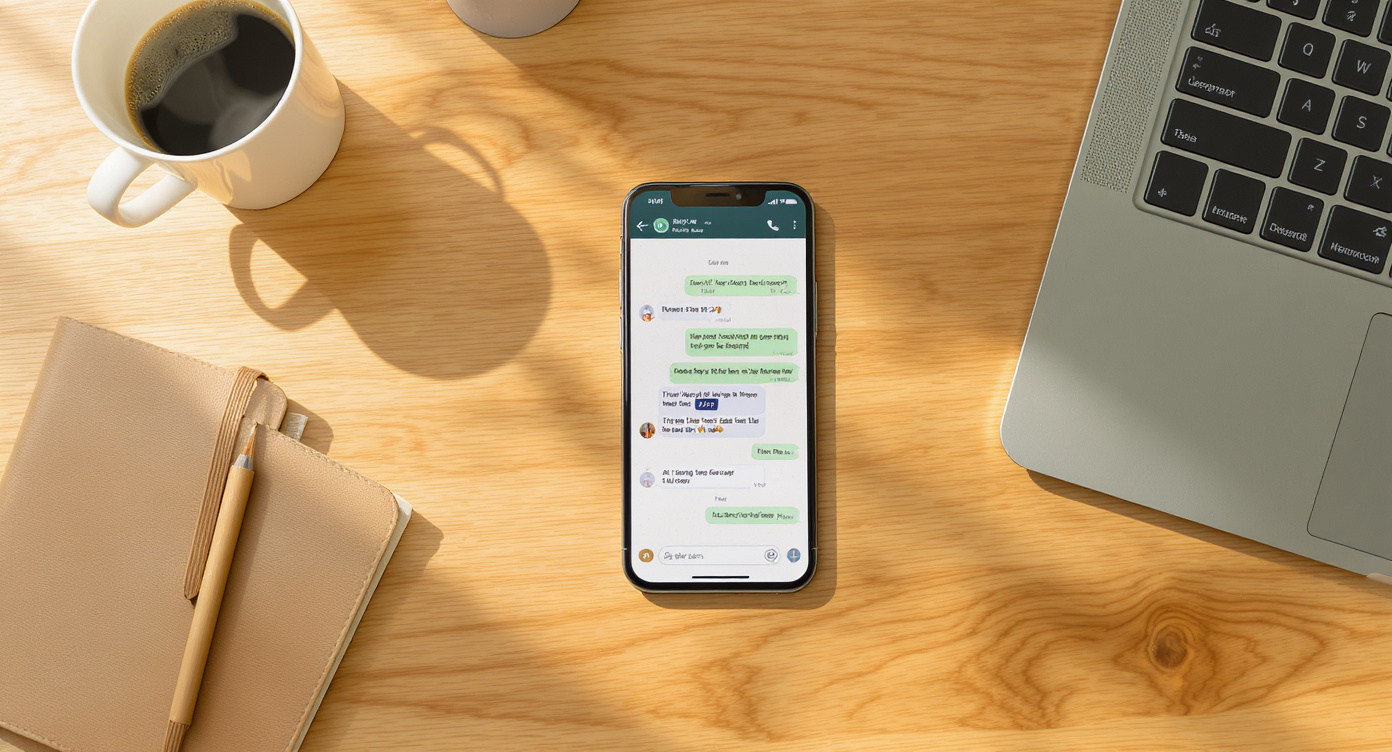
It's 10:30 p.m. A customer opens WhatsApp and sends a message to a small jewelry store in Bologna: he wants to know if a bracelet is available in the right size and if he can pick it up on Saturday. The owner is already at the table with his family. The phone is in his pocket, silent.
Thirty seconds later, the customer receives an answer. Clear, precise, in the tone of someone who knows the product well. It is not the owner. It is an AI who has learned to respond exactly like him.
This scene, until recently, seemed the stuff of Amazon or large chains with in-house tech teams. Today it is within the reach of a three-employee jewelry store. And that is exactly the point.
Remember the Facebook "poke"? That wordless digital gesture - a tap, a signal, "I'm here." Nothing complicated, nothing formal. Yet it communicated something. AI on WhatsApp is becoming something similar: a light, immediate, almost instinctive contact. An interaction that does not require the user to learn anything new, to download a different app, to register somewhere.
For Italian SMEs, this change is no longer science fiction or the prerogative of large companies. It is already an accessible reality. And ignoring it has a cost - often silent, but real.
The problem that no SME owner dares to admit out loud.
There is a widespread frustration among Italian entrepreneurs that is rarely said explicitly, but it comes up in every honest conversation: I can't answer to everyone.
"I can't answer everyone."
Think about the typical day of someone running an SME. There are vendors to hear from in the morning, employees to coordinate, a customer in the store who needs attention, the invoice that doesn't add up, the quote that needs to be sent in by today. And in the midst of it all, WhatsApp accumulates messages like snow that settles quietly.
Twelve unanswered messages. Then fifteen. Then someone stops waiting and goes to the competition.
The paradox is that WhatsApp has become, according to recent estimates by We Are Social, the preferred channel for Italians to contact companies. A channel that customers love because it is convenient, informal, immediate. And which for many SME owners has become a source of creeping guilt: messages piling up, opportunities vanishing.
Silence is not neutrality. An unanswered message within a few hours is, in most cases, a lost sale-and often a lost customer.
The paradox of growth: more customers, less time.
There is a precise moment in the life of a functioning SME when everything gets complicated: when it starts to really grow. The volume of inquiries increases, people find you more easily, word of mouth works. The problem is that time remains the same.
Hiring dedicated WhatsApp customer service staff is often out of budget, at least in the initial stages. And partial solutions-responding only during business hours, using standard WhatsApp Business automated responses-are no longer enough. Customers expect something more.
According to ISTAT data, SMEs represent more than 99 percent of Italy's business fabric. They are the backbone of the economy. Yet when it comes to customer service technology, the public debate is dominated by the needs of large companies - as if small businesses do not have the same needs, or do not deserve equally effective tools.
Competition doesn't wait
Large companies have sophisticated chatbots, integrated CRMs, dedicated 24-hour customer service teams. SMBs risk appearing "slow" in the eyes of consumers accustomed to instantaneity. This is not about competing with Amazon. It's about not falling behind on one concrete aspect: speed of response. Because that, the customer compares it anyway.
What if the solution is already in the tool you use every day?
WhatsApp is not just messaging: it's the new customer counter.
There is a very common cognitive mistake among entrepreneurs: treating WhatsApp as a personal app that happened to be among business tools, instead of recognizing it for what it has become-a real business infrastructure.
The numbers that make WhatsApp indispensable in Italy.
According to DataReportal data, WhatsApp has more than 35 million active users in Italy. It means that nearly two out of three Italians use it - and many open it several times a day.
This has an immediate practical consequence: WhatsApp is already where your customers are. You don't have to convince them to download a new app, create an account, learn something. They already know how it works. They use it to talk to their grandmother, their colleagues, their GP. Bringing your customer service to WhatsApp is not an added complexity -- it's meeting customers where they already live.
From personal chat to professional channel.
WhatsApp has over time built an infrastructure designed for businesses. WhatsApp Business - the small business app - already allows you to set up schedules, product catalog, quick replies. But it is the WhatsApp Business API that is the real paradigm shift: the interface that allows WhatsApp to connect to external platforms, CRM systems, and - here's the thing - conversational AI agents.
The difference is substantial:
- The owner's manual responses are spontaneous but not scalable
- The basic automated responses of the classic WhatsApp Business chatbot are rigid - a message that says "Thank you, we'll get back to you soon" doesn't convince anyone
- The AI conversational agents via API are something else: They understand the context, respond naturally, know when to hand the conversation over to a human operator
The digital "poke": why WhatsApp lowers defenses.
There is a specific psychology to this channel. WhatsApp is perceived as an intimate, almost personal space. Less formal than an email - which often ends up ignored - less invasive than a phone call, which is often not even answered.
The result? People open WhatsApp messages with a frequency that emails wouldn't even dream of. According to some industry research, open rates on WhatsApp can exceed 90 percent, compared to the average 20-25 percent for email campaigns. That's a huge gap, one that completely changes the calculus on where it's worth investing in customer acquisition and retention.
When an AI responds on WhatsApp in a natural way - without the rigidity of a classic chatbot, without pre-packaged formulas - the customer perceives a real interaction. It is, precisely, the digital "poke": a light, immediate contact that simply says "we are here."
Conversational AI agents: what they really are (without unnecessary technicalities).
"Artificial intelligence" has become such an overused label that it is in danger of saying nothing anymore. When we talk about conversational agent AIs for WhatsApp, what are we actually talking about?
Imagine training the best member of your staff on customer service. He knows your products, your return policies, your hours, your prices. He knows when the customer needs reassurance and when he just wants a dry answer. He knows when he can't handle a situation and passes the ball to you.
A conversational AI agent functions similarly-with some important differences: it doesn't get tired, it doesn't go on vacation, it responds at 3 a.m. with the same quality as at 10 a.m., and it handles fifty conversations at once without losing the thread of any.
It is not magic. It is technology that has reached sufficient maturity to be useful-really useful-even to an SME with three employees and an SME budget.
Handoff: when AI realizes it is not enough.
One of the things that scares first-time thinkers the most is this: "What if the AI says the wrong thing? What if it can't respond?"
This is a legitimate concern. Serious automation platforms for SMBs handle exactly this scenario with the handoff mechanism: when the conversation exceeds the skills configured for AI, the system automatically transfers to a human operator. Without the customer experiencing the transition as a problem - simply, smoothly.
This balance between automation and human oversight is key. It's not about replacing people, but amplifying what you already do - freeing up people's time for interactions that really require human intelligence.
What actually happens when AI responds instead of you.
Leave aside the technical language for a moment. Imagine the practical scenario.
You have a small hotel. Every week you receive dozens of WhatsApp messages: requests for availability, questions about parking, check-in times, whether you can bring your dog. Legitimate, but repetitive questions - the same five questions, in endless variations, every week.
With a properly configured AI agent, those questions are handled immediately, at any time, without you having to touch the phone. The customer gets an answer in 30 seconds. You focus on what really adds value: welcoming guests, curating the experience, handling complex situations.
The same is true for a firm that wants to qualify potential clients before scheduling an appointment, for an e-commerce business that gets inquiries about order status, for a restaurant that wants to handle reservations without keeping someone glued to the phone all day.
Platforms like Leader24 are designed for exactly that: to bring conversational AI to WhatsApp and the website in a way that is accessible to SMBs-without requiring an in-house tech team, without months of implementation, without having to understand how an API works in detail. You can directly explore supported industries to see if your market is already covered.
The results that SMEs are already seeing.
It's not theory. Look at case studies of companies that have already integrated AI on WhatsApp into their customer service. The most frequent improvements are in three precise areas:
- Response time: from hours to seconds, h24, with no exceptions related to day of the week or time of day
- Lead qualification: AI collects key information before passing the contact to the team, so responders already have all the necessary context
- Reduction of operational load: repetitive questions are handled automatically, freeing up people for interactions that really require human attention
These are not made-up percentages. These are scenarios that are repeated every time an SME stops responding by hand to every single message and starts automating intelligently.
Because "simple" does not mean "less effective."
There is a subtle bias worth dismantling: the idea that if something is easy to use, it must necessarily be less powerful. As if complexity were a guarantee of quality.
In the case of artificial intelligence applied to WhatsApp, it is exactly the opposite. Simplicity is the result of serious work done upstream. Someone has already solved the complex technical problems -- API integration, natural language handling, handoff logic, data security -- so that you don't have to.
Your job is to define what your AI agent needs to know and how it needs to respond. The rest is already done.
This lowering of the barrier to entry is the real news. Not that AI exists-that we have known for years. But that it has become mature and accessible enough to be used by an artisan ice cream shop owner who has never heard of APIs in his life.
The question you should be asking yourself today.
AI on WhatsApp is not something that big companies are testing and then-perhaps someday-it will come to SMBs. It's already here, it's already accessible, and your competitors are already evaluating it.
The real question is not "does it make sense for me?" It is "how much does it cost me to wait?"
Every unanswered message is a conversation that hasn't been born. Every customer who waits hours for simple information is a customer who learns to expect little from you-not out of malice, but because he or she adapts, inevitably, to the channels that respond faster.
Facebook's "poke" has taught us that the most effective digital interactions are often the lightest, most immediate, closest to a human gesture. AI on WhatsApp is learning the same lesson. Italian SMEs that figure it out first are building a competitive advantage that, over time, becomes harder and harder to close.
Ready to transform your customer service?
Activate your AI assistant on WhatsApp in 5 minutes. 30-day free trial, no credit card required.
Related articles
How to Automate Business Processes Without Writing Code
Learn how to design efficient business workflows and automate repetitive tasks using no-code tools, without having to code.

Learn how to adapt the tourism industry to climate change
The weather affects bookings. Find out how to adjust your offerings for different seasons, manage requests, and turn the weather into a competitive advantage.
Synthetic Threats: How to Protect Your Business from AI Fraud
Find out how synthetic threats use artificial intelligence to deceive professionals and businesses. Protect yourself with practical, simple strategies.